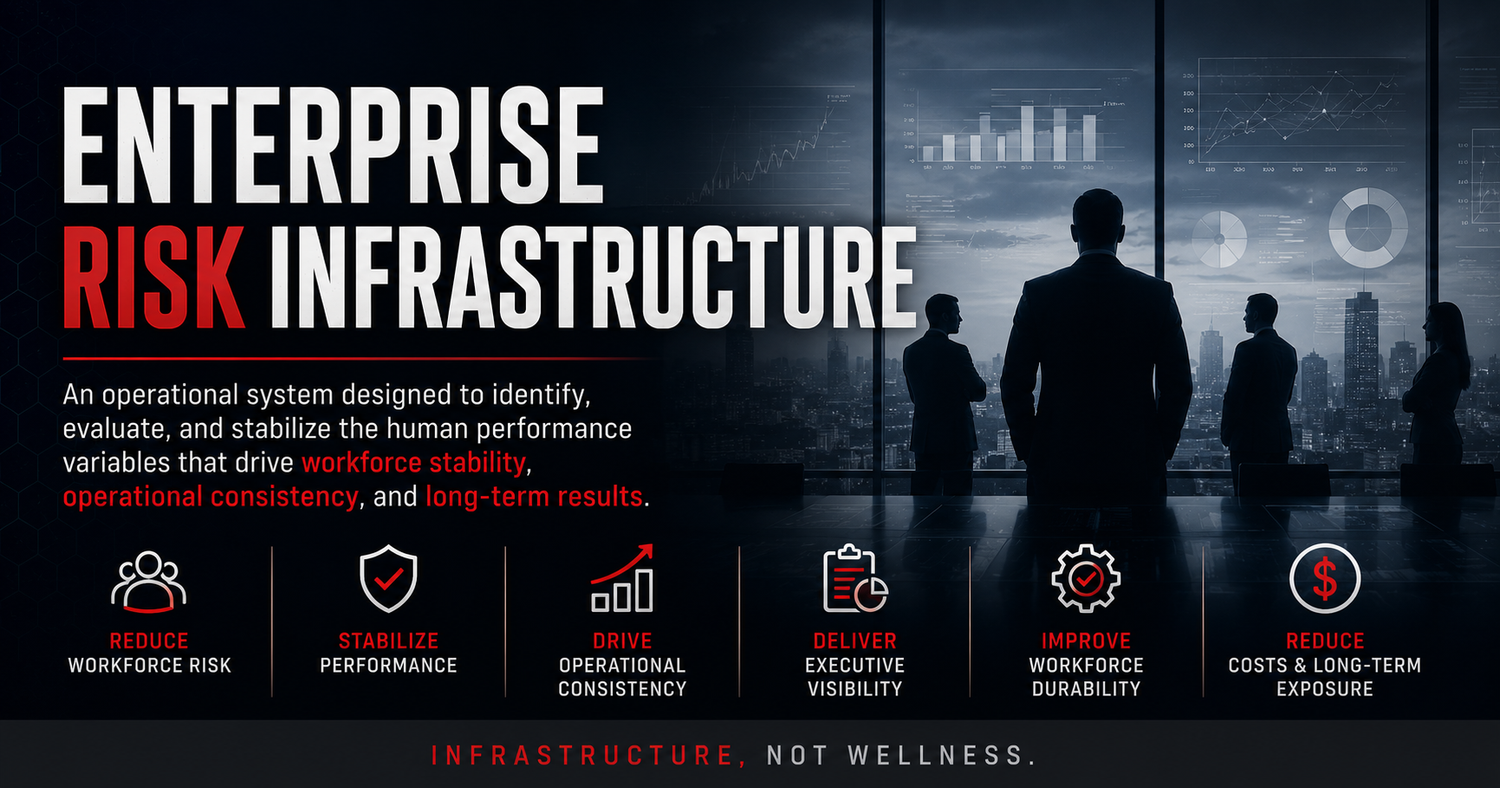
ENTERPRISE RISK INFRASTRUCTURE
Modern organizations spend enormous amounts of money reacting to healthcare costs, absenteeism, turnover, injuries, burnout, and declining workforce performance after those problems have already become expensive operational realities.
Enterprise Risk Infrastructure was developed around a different question:
What if the majority of workforce instability could be identified, measured, and stabilized upstream before those costs compound?
This is not a wellness initiative.
It is not corporate fitness.
It is not another engagement program.
It is an operational infrastructure system designed to help organizations better understand and stabilize the human performance variables that directly influence operational consistency, healthcare volatility, workforce durability, productivity, absenteeism, injury exposure, and long-term organizational risk.
THE PROBLEM
Most organizations are managing the downstream consequences of unstable workforce performance without evaluating the upstream variables driving them.
Those consequences often appear as:
increasing healthcare volatility
absenteeism
presenteeism
injury exposure
fatigue
reduced cognitive performance
inconsistent workforce output
declining physical resilience
long-term operational instability
These issues are often treated as isolated events when, in reality, they are frequently interconnected patterns tied to measurable human performance variables across the workforce.
Organizations routinely analyze financial performance, operational efficiency, cybersecurity exposure, legal risk, and supply chain volatility.
Very few are evaluating workforce human performance infrastructure with the same level of operational seriousness.
THE REALITY
Current metabolic health data in the United States suggests approximately 93.2 percent of adults are metabolically unhealthy.
That reality carries significant implications for workforce durability, recovery capacity, fatigue, cognitive performance, absenteeism, injury risk, healthcare utilization, and long-term operational consistency.
Most organizations are already paying for these issues financially whether they formally recognize them or not.
The question is not whether workforce instability exists.
The question is whether organizations are identifying and stabilizing it early enough to reduce long-term operational exposure.
WHAT ENTERPRISE RISK INFRASTRUCTURE IS
Enterprise Risk Infrastructure is a workforce-focused operational framework designed to help organizations identify, evaluate, monitor, and improve upstream workforce performance variables before they compound into larger operational and financial problems.
The system focuses on measurable human performance infrastructure tied directly to workforce consistency and operational stability.
This is not built around:
step challenges
generic wellness campaigns
motivational initiatives
surface-level engagement programs
temporary corporate fitness trends
The focus is operational stability, workforce durability, performance consistency, and long-term organizational resilience.
WORKFORCE RISK STABILIZATION ASSESSMENT
The Workforce Risk Stabilization Assessment is the core operational framework of Enterprise Risk Infrastructure.
Using structured evaluation periods across 30, 60, and 90 days, organizations are able to better identify workforce risk concentration patterns, operational instability indicators, and measurable areas of human performance exposure.
The assessment is designed to help organizations determine:
where workforce instability is concentrated
which upstream variables are contributing most significantly
how performance volatility trends over time
whether measurable stabilization improvements occur during the evaluation process
The goal is not perfection.
The goal is identifying whether operational risk tied to workforce instability can be better stabilized, measured, and improved over time.
WHAT IS EVALUATED
The system evaluates several core human performance infrastructure variables that directly influence workforce durability, recovery capacity, operational consistency, and long-term performance stability.
These include:
movement capacity and physical activity patterns
nutritional quality and fueling behaviors
sleep quality and recovery capacity
stress load and recovery management
hydration and electrolyte balance
alcohol and substance exposure patterns
These variables are evaluated operationally based on their relationship to workforce consistency, fatigue, recovery, resilience, and performance stability.
DELIVERABLES
Organizations receive structured operational reporting designed to provide executive-level visibility into workforce performance stability trends and risk concentration areas.
Deliverables may include:
Workforce Risk Concentration Mapping
Operational Volatility Tracking
Executive Risk Summaries
Workforce Trend Analysis
Performance Stability Reporting
Operational Exposure Indicators
30 / 60 / 90 Day Comparative Analysis
Structured Organizational Findings
WHO THIS IS FOR
Enterprise Risk Infrastructure is designed for organizations seeking a more operational and measurable approach to workforce performance stability and long-term organizational risk reduction.
This may include:
CEOs
CFOs
COOs
Human Resources leadership
Operations leadership
Mid-size organizations
Enterprise organizations
INFRASTRUCTURE, NOT WELLNESS
Enterprise Risk Infrastructure was built around a simple reality:
Healthcare volatility, absenteeism, injury exposure, fatigue, and workforce inconsistency are not random operational events.
They are often the downstream result of unstable upstream human performance variables.
Organizations already measure nearly every other major area of operational risk.
Enterprise Risk Infrastructure was developed to help organizations evaluate and stabilize the human side of operational performance with the same level of structure, seriousness, and long-term thinking.
REQUEST INFORMATION
For organizational discussions, assessment inquiries, or additional information regarding Enterprise Risk Infrastructure, please use the contact form below or schedule a direct discussion.